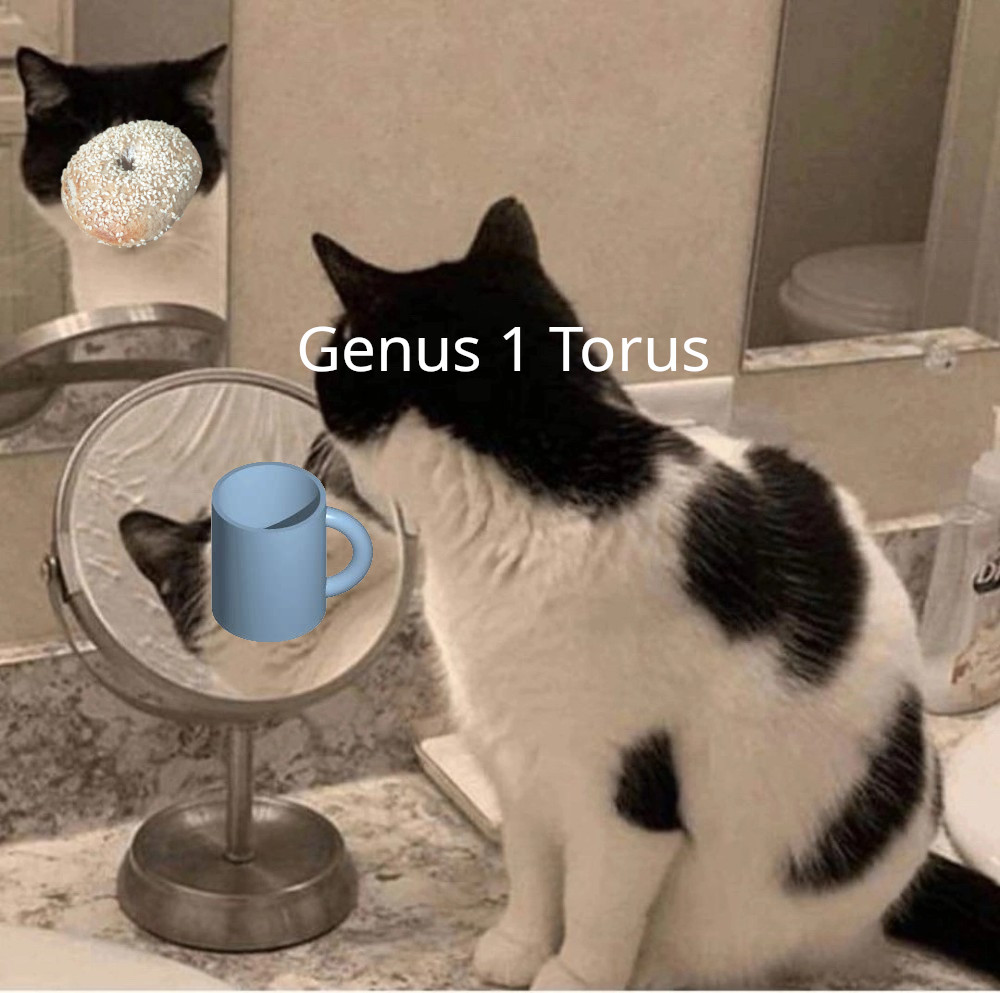
There is a joke that topologists cannot distinguish between a bagel1 and a coffee mug. The reason for this is that topologically speaking, they are equivalent (or homeomorphic, to use the precise term). If we had a coffee mug that was made out of modelling clay, we could collapse the “inside” of the mug and be left with just the handle, i.e. a bagel. In a sense, they both just have one hole, the one in the middle/handle. Therefore, they are topologically equivalent. We call this shape a torus of genus $1$.
One-dimensional holes
Topologists consider this hole to be one-dimensional. Intuitively, this may seem confusing: “inside” the hole, there is a disk missing, i.e. a two-dimensional manifold. By trying to give the hole a dimension from this approach, we are characterizing it by what is missing. For this to work, our topological space has to be contained in another, bigger space. For the bagel, this is $\mathbb{R}^3$. Furthermore, the containing space should not contain any holes itself, because if something is already missing in the bigger space, we cannot detect it in the smaller one. To avoid the issue of needing this containing space, we use a different idea to find holes: we cast out nets and try to catch them. (This analogy is due to (Kreck 2010).) For one-dimensional holes, our net is the circle $S^1$, which is a one-dimensional manifold. Then we name the hole after the net needed to catch it instead of what is missing. We cast out the net by mapping it into the space we are investigating. If we can collapse it to a single point with a continuous deformation, then our net came back empty. However, if we cannot do that, then something got stuck and we have caught a hole. If we cast this net around the hole in the middle of the bagel or the handle of the mug, then we cannot collapse it, meaning we found a hole. A torus of genus $1$ is hollow, so we can also cast the net around the vertical crosssection, finding another hole. But this is not the case for the bagel and the mug. The mug is filled (i.e. solid on the inside) and a real bagel contains many small holes, but not one that goes around fully:
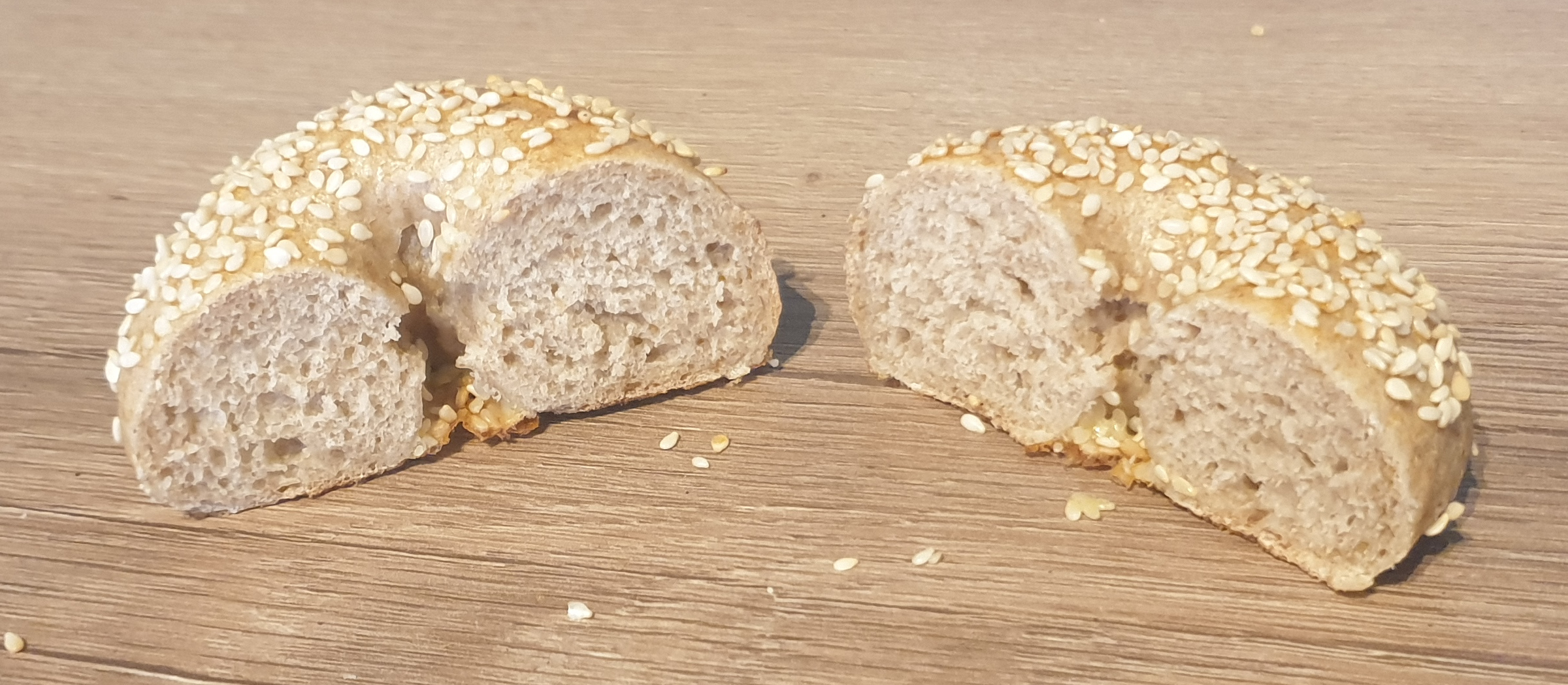
The bagel situation is similar to a filled ball and a hollow sphere: if we look at a filled ball, we see that all nets can easily be collapsed to a point by pulling them to the center. But the same can be done on the hollow sphere by imagining the circle like a rubber band on the ball, which pulls itself tight. So they both do not have any one-dimensional holes, although there is a clear hole in the hollow sphere. With similar reasoning, we can see that the small holes in a real bagel are not one-dimensional. So the holes inside a bagel and a hollow sphere must be holes of a different kind.
Two-dimensional holes
For one-dimensional holes, it seemed like there was a disk missing. Now the hole in the hollow sphere and the ones in the bagel seem spherical, so of dimension three. Earlier our intuition was one dimension off, so let’s use a two-dimensional manifold to try and catch this hole. Then our net is the hollow sphere $S^2$. If we map it to the filled ball, we see that we can still just pull everything to the center, collapsing it. Thus there is no two-dimensional hole here. If we map it to the hollow sphere though, we cannot collapse it anymore. If we imagined again it was made out of rubber, it would still not be able to pull itself tight without ripping somewhere. This is similar to a balloon: it wants to collapse, but this is not possible, until you puncture it. Thus the hollow sphere has indeed a two-dimensional hole. We can map $S^2$ in the same way around all the little holes in the bagel and see that they are also two-dimensional holes.
Holes in higher dimensions
We can also use the hyperspheres $S^n$ to characterize holes of even higher dimensions. For example, we can use the three-dimensional hypersphere $S^3$ to detect three-dimensional holes. But since these can only appear in manifolds of dimension four or higher, they are hard to imagine and are not useful for baking or life in general. One fun example actually comes from the other direction: what if we consider $S^0$? By everything we have seen, this should show us zero-dimensional holes. Since $S^0 = \{-1,+1\}$, we can collapse it in every path-connected topological space, because then we have a path between every two points by definition and can move $-1$ to $+1$. A space consisting of two disconnected parts, like two separate balls, has a zero-dimensional hole, since we can place $+1$ on one ball and $-1$ on the other. Then there is no way to bring them together. Thus, zero-dimensional holes characterize the path-connected components in a topological space.
Topological baking
As we have seen, a bagel contains many small two-dimensional holes. The dough just after mixing however is solid and contains none or just a few holes. After fermenting for a while, there are more. Since a continuous deformation can never create new holes, the map that transforms the mixed dough to its risen state is not continuous. So in case someone tells you that in reality everything is nice and smooth, you can answer that the rising deformation is not even continuous. Personally I am happy about this, because who wants to eat non-risen bread all the time?
Bibliography
Kreck, Matthias. 2010. Differential Algebraic Topology. From Stratifolds to Exotic Spheres. Vol. 110. Grad. Stud. Math. Providence, RI: American Mathematical Society (AMS).
-
The usual formulation of this joke involves donuts, but they are unhealthy and this gave me a reason to make bagels. ↩︎