When we say that Sherlock Holmes is a detective, or that the golden mountain is golden, or that the round square is impossible, we seem to be saying something. We can distinguish Holmes from Pegasus, ask whether the golden mountain has any properties beyond its name, and disagree about what makes the round square impossible in the first place. None of these objects exists. Yet they have properties, they get talked about, and they get reasoned about, and ordinary logic does not give us a clean way to handle them. Meinongian logic is the family of logics that does. This piece is a short introduction to it, and to a recent way of building one of these logics out of truthmakers rather than possible worlds.
What makes a logic Meinongian
A Meinongian logic is one that allows reference to, predication of, and quantification over objects that do not exist.1 The position is named after Alexius Meinong (1853–1920), and its defining thought is what Meinong called the independence of Sosein from Sein: an object’s having of properties does not depend on its existing. Holmes is a detective whether or not he exists, the golden mountain is golden and a mountain whether or not there is any such thing, and our talk about them is about those very objects, not about something else.
Formally, this has two consequences for the language. First, the domain $D$ of a Meinongian model is a domain of objects, not of existents. Holmes and the golden mountain are in $D$ alongside Napoleon and the Eiffel Tower. Second, existence is not built into the quantifier. Most Meinongian logics use two quantifiers, an unloaded one $\Sigma$ ranging over all of $D$, and a loaded one $\exists$ ranging only over the existing objects. The two are connected through a primitive existence predicate $E$:
$$\exists x\, \varphi \;:=\; \Sigma x\,(E(x) \wedge \varphi).$$So existence becomes a real first-order property that some objects have and others do not, rather than something built into the meaning of the quantifier. To say there are non-existent objects is then to say $\Sigma x\, \neg E(x)$, which is no longer the contradiction it would be in classical logic.
That gives us the basic shape. What still needs settling is how non-existent objects get into the domain in the first place. They get there by being characterized. A characterizing condition, written $\alpha[x]$, is a formula that specifies a combination of properties, and a Meinongian logic associates with each such condition an object of $D$ that satisfies it. The golden mountain is the object characterized by “$x$ is golden and $x$ is a mountain.” Holmes is the object characterized by the relevant conjunction of Conan Doyle’s predications. The round square is the object characterized by “$x$ is round and $x$ is square.”
The Characterization Principle
Naively, the way to say this is:
$$\text{For every } \alpha[x], \text{ there is an object } d \text{ such that } \alpha[d].$$This is the Characterization Principle (CP). It looks innocent, but Russell long ago observed that an unrestricted version trivializes existence. Take the condition “$x$ is a golden mountain and $x$ exists.” The naive CP introduces an object satisfying this condition, hence an existing golden mountain, hence a golden mountain exists. We have read existence out of thin air, by writing it into a definition.
The standard contemporary response is Modal Meinongianism, developed by Graham Priest (Priest 2016) and Francesco Berto (Berto 2013). The key move is to weaken CP so that a characterization is satisfied not necessarily at the actual world, but at some world, possibly a non-actual or impossible one. So we have a set of worlds $W = W^P \cup W^I$, partitioned into possible and impossible worlds, and:
$$(\text{QCP}) \quad \text{For every } \alpha[x], \text{ there is an object } d \text{ and a world } w \text{ such that } \alpha[d] \text{ holds at } w.$$The golden mountain, then, is golden and a mountain at some non-actual possible world. The round square is round and square at some impossible world (you cannot have it at a possible one, since being round and square is impossible). And “the existing golden mountain” has its characterization satisfied at some non-actual world, which is no commitment to anything actual: the object exists there, not here. Russell’s worry is defused.
This is a workable Meinongian logic. It has a domain of objects, including non-existents and inconsistent ones; it interprets predicates relative to worlds; it has unloaded and loaded quantifiers; and the QCP populates the domain.
States, parts, and exact verification
There is, however, a more discriminating way to build a semantics for a Meinongian logic, and that is what the second half of this piece is about. The shift is not particular to Meinongianism. It is part of the larger hyperintensional turn in philosophy: an account of content is hyperintensional when it distinguishes contents that are necessarily, or even logically, equivalent. Possible-worlds semantics is not hyperintensional, since two formulas true at exactly the same worlds get the same content. For many purposes this is fine. For some it is not. Theories of essence, of ground, of subject matter, and of belief have all needed a finer notion of content than worlds provide.
One leading framework here is Fine’s exact truthmaker semantics (Fine 2017). Instead of asking at which worlds $\varphi$ is true, it asks what exactly verifies $\varphi$. A state $s$ exactly verifies $\varphi$ when it is wholly relevant to $\varphi$, with no irrelevant part. Rain exactly verifies “it is raining.” The state of rain together with the state of wind does not, because the wind is irrelevant.
Three features distinguish the framework from worlds semantics. First, content is bilateral: each formula has both a set of verifiers $\llbracket\varphi\rrbracket^{+}$ and a set of falsifiers $\llbracket\varphi\rrbracket^{-}$, with falsifiers carrying positive content of their own rather than being the absence of verification. Second, states have part-whole structure: a state can be a part of another, and two states can be fused into a third, $s \sqcup t$. The state of raining is a part of the state of raining-and-windy; their fusion is what makes the conjunction true. Third, content is compositional in this structural sense:
$$\llbracket \varphi \wedge \psi \rrbracket^{+} = \{\, s \sqcup t : s \in \llbracket \varphi \rrbracket^{+},\; t \in \llbracket \psi \rrbracket^{+} \,\}.$$A verifier of a conjunction is built by fusing verifiers of the conjuncts. Disjunction works analogously on falsifiers, and negation simply swaps verifiers and falsifiers. The clauses are uniform: they make no reference to worlds, because there are no worlds; there are only states.
The setting is hyperintensional because two formulas true at exactly the same worlds can have different exact verifiers, simply because they are made true by different things. So “$2+2=4$” and “$P \vee \neg P$” are true at the same worlds (all of them) but have different verifiers.
The connection between truthmaking and Meinongian objects is not new. Sendłak, for one, reads talk of possible worlds in terms of Meinongian states of affairs (Sendłak 2022). What follows takes a further step, and builds the Meinongian logic itself out of states.
A Meinongian truthmaker model
What I want to suggest in the rest of this piece is that this is the right setting in which to do Meinongian logic. The result is a Truthmaker Meinongian Model (TMM). The components are a space of states $S$ ordered by parthood, a possible region $P \subseteq S$ (everything outside it is impossible), a concrete region $C \subseteq P$ in which existence lives, a Meinongian domain $D$ of objects, an actual state $s_0 \in C$, and a valuation that gives each predicate a verifier-falsifier pair and gives each characterizing condition a definite object as referent. There are no worlds.
The truthmaker setting is Fine’s and the Meinongian ideas are the tradition’s; the way of putting the two together, the Truthmaker Meinongian Model, is my own proposal, and I work it out in full in my master’s thesis. It is still in progress, so I offer it here as a sketch rather than a settled result: please do not cite this piece, though any comment is most welcome.
Three things change relative to the world-based picture. First, the Characterization Principle now requires that the object assigned to a condition $\alpha$ actually carries verifying content for $\alpha$. Some state in the model verifies $\alpha$ of the assigned object. This gives a characterization term, written $\iota x\, \alpha[x]$ and read “the object characterized by $\alpha$,” a definite referent, rather than only the existential statement that some object satisfies $\alpha$.
Second, impossibility is structural. Take any predication $F(d)$. The single rule called Exclusivity says that if $r$ verifies $F(d)$ and $r'$ falsifies $F(d)$, then their fusion $r \sqcup r'$ lies outside $P$. Impossibility, in other words, is generated: it falls out of the predicate valuation and the fusion operation, rather than being stipulated by sticking sentences into arbitrary sets. The round non-round, characterized by $R(x) \wedge \neg R(x)$, has verifiers built from $R$-verifiers and $R$-falsifiers fused together, and by Exclusivity those fusions are impossible. We did not have to tell the model that they were. This is where the truthmaker model earns its keep against the modal one. Modal Meinongianism has to place the round square at some impossible world, but which impossible world, and which impossibilities exist at all, is left to stipulation, since its impossible worlds are just arbitrary sets of sentences. Here there is nothing to stipulate. The round non-round is impossible because Exclusivity makes the fusion of a verifier and a falsifier impossible, and that follows from the content of its condition alone.
Third, objects are individuated by their full content. Each object $d$ has a verification assignment, $\mathrm{VA}_{d}$: a function that records, for every predication, what verifies and what falsifies it of $d$. Two objects are identical exactly when they have the same verification assignment. This is the formal counterpart of Meinong’s Sosein: the totality of how an object is characterized, independent of whether it exists. Two distinct inconsistent objects can now differ structurally, not just by stipulation. The round square has verifiers built from $R$-verifiers and $Sq$-verifiers; the round non-round has verifiers built from $R$-verifiers and $R$-falsifiers. Different parts, different content. Different objects, by construction.
Take the following example for illustration. Consider Holmes and a stipulated near-twin, Schmolmes, characterized exactly as he is but for one change: where Holmes plays the violin, Schmolmes never took it up. Everything else, the Baker Street address, the detective work, the rest, they share. So the model gives them the same verifiers and the same falsifiers everywhere but on one predicate: “plays the violin” has a verifier at Holmes and a falsifier at Schmolmes. Their verification assignments differ by exactly that one pair, and the identity criterion asks for no more than that. They are two objects, not one, even though a list of all their other properties would not tell them apart.
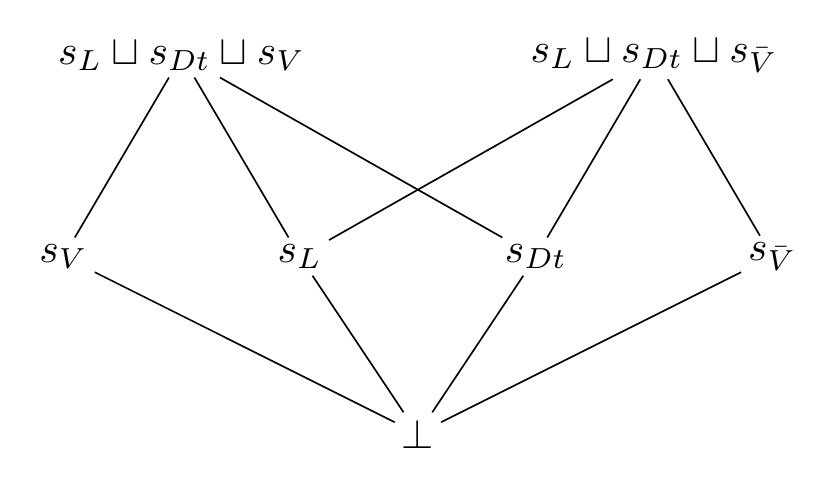
That is the kind of distinction a Meinongian logic needs, and it is one that the part-whole structure of states yields on its own. The Meinongian who once seemed to be populating their logic with creatures stitched together by stipulation now has them put together out of parts. These objects were always more sharply defined than the tradition allowed; we simply lacked a semantics with parts fine-grained enough to bring the differences out.
Bibliography
Berto, Francesco. 2013. Existence as a Real Property: The Ontology of Meinongianism. Vol. 356. Synthese Library. Springer. https://doi.org/10.1007/978-94-007-4207-9 .
Fine, Kit. 2017. “Truthmaker Semantics.” In A Companion to the Philosophy of Language, edited by Bob Hale, Crispin Wright, and Alexander Miller, 2nd ed., 556–77. Chichester: Wiley-Blackwell.
Jacquette, Dale. 1996. Meinongian Logic: The Semantics of Existence and Nonexistence. Vol. 11. Perspectives in Analytical Philosophy. Berlin; New York: Walter de Gruyter.
Priest, Graham. 2016. Towards Non-Being: The Logic and Metaphysics of Intentionality. 2nd ed. Oxford: Oxford University Press. https://doi.org/10.1093/acprof:oso/9780198783596.001.0001 .
Sendłak, Maciej. 2022. “Truthmaking for Meinongians.” Synthese 200 (55). https://doi.org/10.1007/s11229-022-03541-0 .
Zalta, Edward N. 1983. Abstract Objects: An Introduction to Axiomatic Metaphysics. Dordrecht: D. Reidel.
-
A Meinongian logic should not be confused with a free logic. Both make room for terms that seem to name nothing, such as the golden mountain, but they do so in opposite ways. A free logic lets a singular term fail to denote, and it keeps the quantifiers committed to existence, so that they range over existing objects alone (Zalta 1983). On this approach there are no non-existent objects, and the golden mountain denotes nothing. A Meinongian logic takes every such term to denote an object, and it treats existence as a property that an object may have or lack (Jacquette 1996; Berto 2013). The domain over which its basic quantifier ranges then contains non-existent objects alongside existent ones. In the system sketched here every characterizing condition has a referent, and existence is given by a separate predicate. The existentially loaded quantifiers, defined from that predicate, range over the existent objects alone, as the quantifiers of a free logic do. ↩︎