We’ve all been there: it’s grandma’s birthday so you’re at her apartment in Roosendaal with your whole family. Your uncle is talking about how he’s using the A.I. at his work and says that all the kids these days are using chapgtt for their assignments. He looks at you with a smirk, ‘Right?’ You say ‘Hmmm, well, I don’t know’, and mumble something about neuro-symbolic bla bla explainable bla bla until he loses interest. A few minutes later: Bingo. Your grandpa asks you (like every time) ‘Wat is dat ook alweer, dat logica?’1. Hahaha, how to start? Well maybe you say something about first order logic (maybe model theory? No, actually, that’s way too much), or perhaps you try to explain Frege’s puzzle. Yeah, that’s a good idea! But before you’ve even referenced the meaning of modality he’s nodding like that was the end of your story and offering the next person some tea. Well, whatever.
Scientists have recently coined the term abstractophobia for the psychological condition characterised by ‘A repulsion to (discussion of) abstraction or abstract concepts, especially without the explicit mention of a practical, real world, hands-on, impactful, results-driven application and/or example’. Early research suggests that it affects nearly everyone you talk to about your mathematics degree. Symptoms depend on the situation and interlocutor, but mathematicians are often greeted with a ‘I actually hated maths in highschool’ or a ‘So you’re like super smart’ followed quickly by a ‘What do you want to do with that?’ Chronic abstractophobia leads to hyperfixation on the tangible (as perceived by the patient). This causes the irresistible urge to ask ‘Is that useful?’ or, ‘Does that have any applications?’
‘Abstractophobes are not just uninterested in set theory or algebra’, explains Dr Zorn Slemma, ‘They have a deep-seated disdain for the concept of abstraction’. One indication of this is the lack of consistency in the discourse around abstraction. A recent study found that patients associated the word ‘abstract’ with both ‘That art that is just splatters of paint and actually my one-month-old infant could also make that’ as well as with ‘That stuff that is way too confusing for my one-month-old infant’. Additionally, researchers found that they could reduce objections of abstractophobes to theorems of real analysis by stating that they could be ‘Used for googoo gaga’ and ‘Help optimise leelee-lala’. In fact, the words ‘use’, ‘apply’, ‘optimise’ and ‘improve’ were all found to significantly reduce discomfort in patients, even when used in a completely incomprehensible way. These results motivated scientists to designate abstractophobia as a legitimate condition.
Scientists are still working to determine exactly the causes of abstractophobia, but here is what they know: Individuals are usually infected with abstractophobia by others, especially when someone they trust starts to say that ‘It can’t hurt to earn a bit of money’ and ‘I don’t think that boolean algebra homomorphisms are the next big thing’. Children of parents who suffer from the condition are also significantly more prone to it themselves, and are less likely to recover. Epidemiologists are thus concerned at the increase in abstractophobia among toddlers, with one study reporting that nearly half of three-year-olds showed a disinterest in placing wooden shapes in the correctly shaped holes of a box. One participant is quoted ‘When will I ever need to use this in real life?’ On the other hand, experts found that the popular internet character ‘Tung Tung Tung Sahur’, a leading figure in online abstract and surreal culture, is particularly popular under the younger generation, so there may be some hope yet.
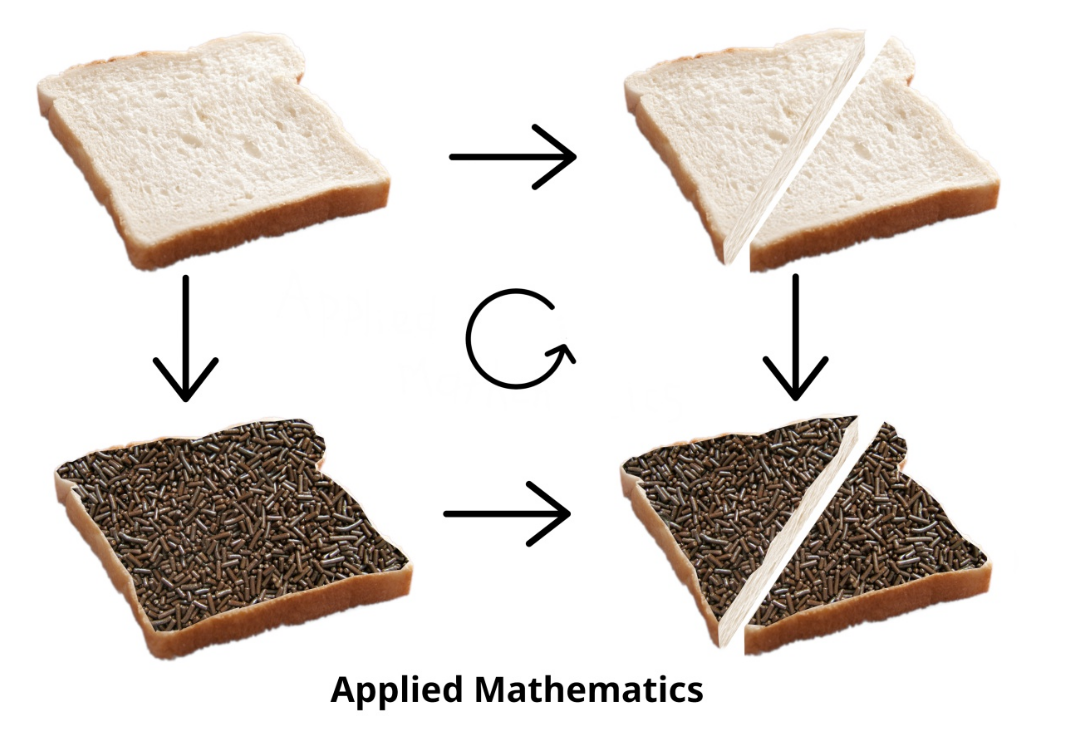
Now, our readers might think that they are not in any danger themselves, since they view the world as a commutative diagram and haven’t thought about an actual natural number in months, but be warned! The government has, for a while now, been concerning itself with an evil plan known as ‘E.C. Onomy’ and to succeed they need to convince you to stop thinking about math and start thinking about cash. That is why universities try at every opportunity to turn the pure mathematics student into an engineer. Career day? More like ‘Ca-n’t-you-study-something-to-make-us-rich-eer day’. Applied maths? More like ‘Appl-ease-help-us-ensure-more-profit-is-realis-ed maths’. In fact, even those ‘students’ who ask the lecturer to ‘Make this more concrete’ and to ‘Give an example’ are actually agents of the state! And this strategy works. One day your buddies are with you, laughing and having fun while learning about algebraic logic, next day they’re sending Phillip-Morris their CV saying that they have ‘Ultra knowledge of proper filters’. Watch out. Nobody is safe.
By describing Abstractophobia, researchers hope to create awareness for the condition, which might eventually lead a cure. In fact, a plan to develop a vaccine has already been drawn up. The idea is to produce an injection $\iota: \text{People} \hookrightarrow \text{People Who Like Maths}$, which is sufficient to eradicate abstractophobia. We hope to bring you good news on this front in the near future.
Next week in $\mathbb{R}$eal $\mathbb{N}$ews: $\aleph_{1}$ reasons your morphisms are not epic.
-
What is it again, that logic? ↩︎